
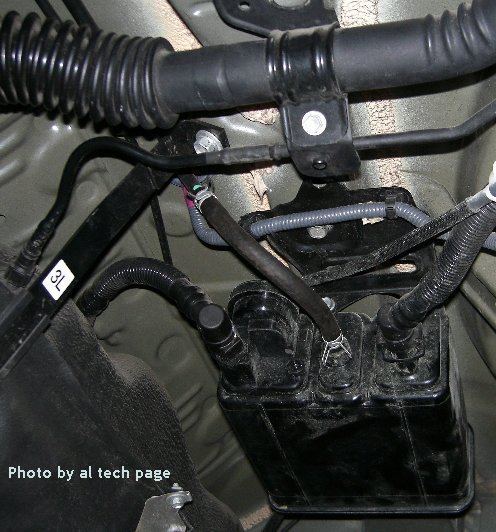
Charcoal canister (EVAP System)


Evaporative Emission Control System (DTC P0440, P0441, P442, P0446, P0450, P0451, etc)
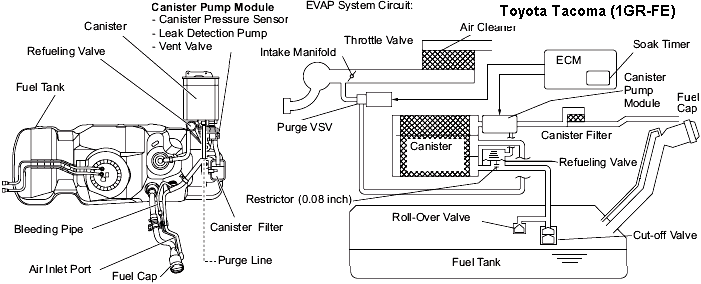
Approximately 20%of all hydrocarbon (HC) emissions from the automobile originate from evaporative sources. The Evaporative Emission Control (EVAP) System is designed to store and dispose of fuel vapors normally created in the fuel system; thereby, preventing its escape to the atmosphere. The EVAP system delivers these vapors to the intake manifold to be burned with the normal air/fuel mixture. This fuel charge is added during periods of closed loop operation when the additional enrichment can be managed by the closed loop fuel control system. Improper operation of the EVAP system may cause rich driveability problems, as well as failure of the Two Speed Idle test or Enhanced I/M evaporative pressure or purge test.
The EVAP system is a fully closed system designed to maintain stable fuel tank pressures without allowing fuel vapors to escape to the atmosphere. Fuel vapor is normally created in the fuel tank as a result of evaporation. It is then transferred to the EVAP system charcoal canister when tank vapor pressures become excessive. When operating conditions can tolerate additional enrichment, these stored fuel vapors are purged into the intake manifold and added to the incoming air/fuel mixture.
The old EVAP control system is a system which utilizes the intake manifold vacuum to draw the evaporative emissions into the intake manifold and mix then in with the intake air. The ECM controls a duty–cycle type VSV (vacuum switching valve) to purge the evaporative emissions from the charcoal canister.
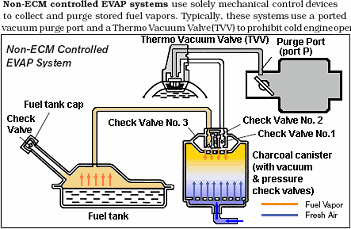
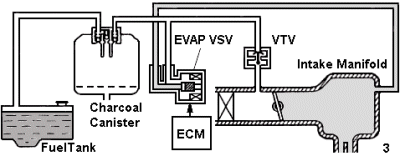
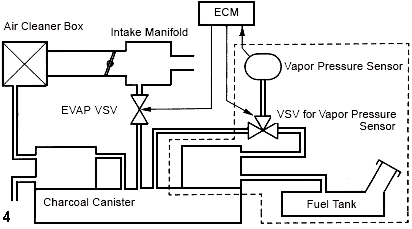
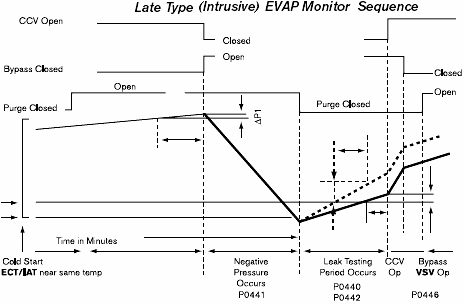
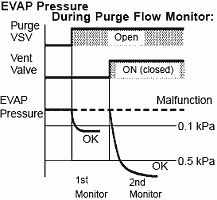
EVAP VSV Monitor (DTC P0441, im3) The ECM controls the opening and closing of the EVAP VSV (vacuum switching valve). When the EVAP VSV is opened, the engine speed and the air/fuel ratio should change. The ECM monitors both of the engine RPM and the air/fuel ratio for this EVAP system diagnostic test. If the ECM does not detect any change in the engine RPM or the air/fuel ratio when opening the EVAP VSV, the ECM will determine that there is a malfunction of the EVAP VSV and set a DTC.
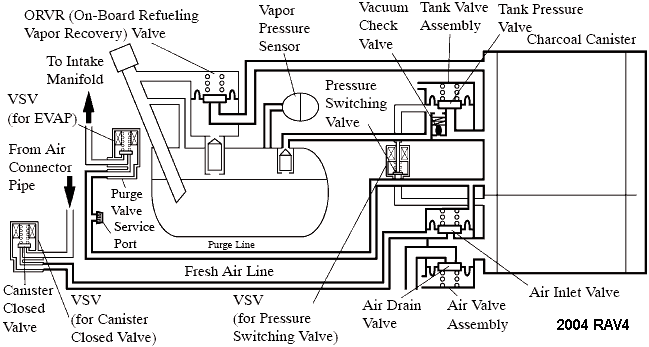
The EVAP control system is a system which utilizes the intake manifold vacuum to draw the evaporative emissions into the intake manifold and mix them with intake air. The ECM controls a duty–cycle type VSV (vacuum switching valve) to purge evaporative emissions from the charcoal canister. The ECM uses the vapor pressure sensor to detect malfunctions in the evaporative emissions (EVAP) system. This diagnostic checks the function of the EVAP VSV and VSV for vapor pressure sensor, the integrity of these components and the fuel tank from the standpoint of fuel vapor emissions. When the VSV for vapor pressure sensor is closed, the ECM monitors the vapor pressure in the fuel tank. When it is open, the ECM monitors the vapor pressure in the charcoal canister. The ECM senses pressure in the fuel tank using the vapor pressure sensor. The ECM supplies the sensor with a regulated 5 V reference–voltage and the sensor returns a signal voltage between 0.5 V and 4.5 V according to the pressure level in the fuel tank. When the pressure in the fuel tank is low, the output voltage of the vapor pressure sensor is low. When it is high, the output voltage is high.
EVAP VSV Monitor (DTC P0441, im.4) In one part of this diagnostic, the ECM switches the EVAP VSV to apply manifold vacuum pressure to the EVAP system. The ECM then monitors the vapor pressure in the charcoal canister. It is normal for the vapor pressure decrease when the EVAP VSV is opened. If the ECM detects no reduction in vapor pressure it interprets this as a “stuck closed” malfunction in the EVAP VSV. In a second part of this diagnostic, the ECM checks the vapor pressure of the charcoal canister with the EVAP VSV off. If the vapor pressure of the canister remains low, the ECM interprets this as a “stuck open” malfunction in the EVAP VSV. In either case, the ECM will illuminate the MIL and set a DTC.
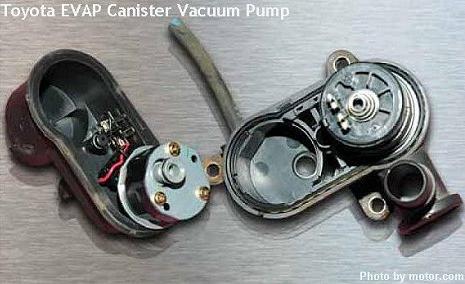
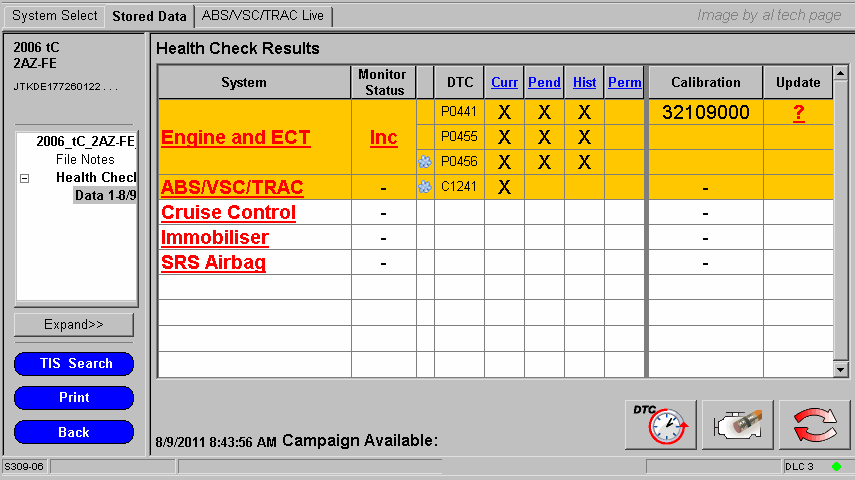
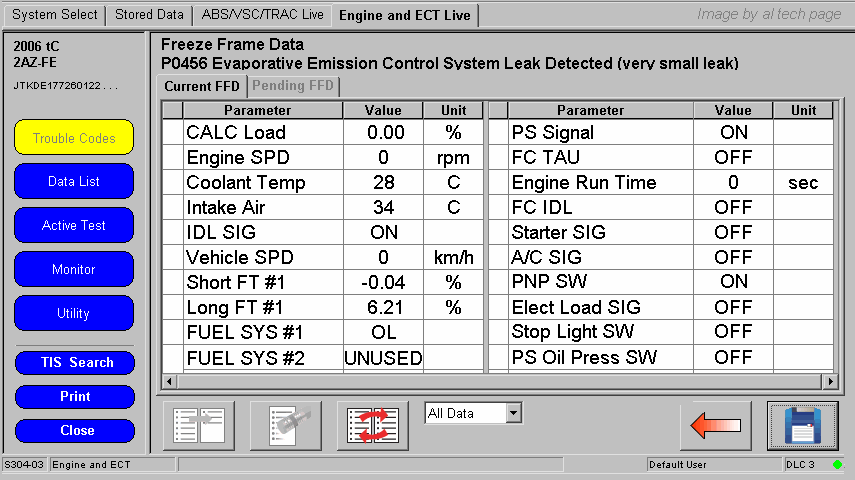
For example, this Scion tC (a '06) Data by TechStream Lite Kit
NEW DTC of EVAP System (for Toyota/Lexus/Scion)
P043E Evaporative Emission System Leak Detection Reference Orifice Low Flow
P043F Evaporative Emission System Reference Orifice High Flow
P0440 Evaporative Emission Control System Malfunction
P0441 Evaporative Emission Control System, Incorrect Purge Flow
P0442 Evaporative Emission Control System Leak Detected (Small Leak)
P0443 Evaporative Emission Control System Purge Control Valve Circuit Malfunction
P0444 Evaporative Emission Control System Purge Control Valve Circuit Open
P0445 Evaporative Emission Control System Purge Control Valve Circuit Shorted
P0446 Evaporative Emission Control System Vent Control Malfunction
P0447 Evaporative Emission Control System Vent Control Circuit Open
P0448 Evaporative Emission Control System Vent Control Circuit Shorted
P0449 Evaporative Emission Control System Vent Valve/Solenoid Circuit
P0450 Evaporative Emission Control System Pressure Sensor Malfunction
P0451 Evaporative Emission Control System Pressure Sensor/Switch Range/Performance
P0452 Evaporative Emission Control System Pressure Sensor/Switch Low Input
P0453 Evaporative Emission Control System Pressure Sensor/Switch High Input
P0454 Evaporative Emission Control System Pressure Sensor/Switch Intermittent
P0455 Evaporative Emission Control System Leak Detected (gross Leak)
P0456 Evaporative Emission Control System Leak Detected (Very Small Leak)
P0457 Evaporative Emission Control System Leak Detected (fuel cap … off)
P1420 Evaporative Emission Canister Small Leak (LS600hL)
P1421 Evaporative Emission Canister Gross Leak (LS600hL)
P1422 Fuel Tank Small Leak
P1423 Fuel Tank Gross Leak
P2024 Evaporative Emissions (EVAP) Vapor Temperature Sensor Circuit
P2025 Evaporative Emissions (EVAP) Vapor Temperature Sensor Performance
P2026 Evaporative Emissions (EVAP) Vapor Temperature Sensor Circuit Low Voltage
P2027 Evaporative Emissions (EVAP) Vapor Temperature Sensor Circuit High Voltage
P2028 Evaporative Emissions (EVAP) Vapor Temperature Sensor Circus Intermittent
P2400 Evaporative Emission System Leak Detection Pump Control Circuit / Open
P2401 Evaporative Emission System Leak Detection Pump Control Circuit Low
P2402 Evaporative Emission System Leak Detection Pump Control Circuit High
P2403 Evaporative Emission System Leak Detection Pump Sensor Circuit I Open
P2404 Evaporative Emission System Leak Detection Pump Sensor Circuit Range/Performance
P2405 Evaporative Emission System Leak Detection Pump Sensor Circuit Low
P2406 Evaporative Emission System Leak Detection Pump Sensor Circuit High
P2407 Evaporative Emission System Leak Detection Pump Sensor Circuit Intermittent/Erratic
P2408 Fuel Cap Sensor/Switch Circuit
P2409 Fuel Cap Sensor/Switch Circuit Range/Performance
P2401 Evaporative Emission Leak Detection Pump Stuck OFF LC ‘06, 2GR-FSE
... Evaporative Emission Leak Detection Pump Stuck ON LC ‘06
P2402 Evaporative Emission System Leak Detection Pump Control Circuit High (LS600hL)
P2410 Fuel Cap Sensor/Switch Circuit Low
P2411 Fuel Cap Sensor/Switch Circuit High
P2412 Fuel Cap Sensor/Switch Circuit Intermittent/Erratic
2419 Evaporative Emission Pressure Switching Valve Stuck ON LC ‘06
P2419 Evaporative Emission System Switching Valve Control Circuit Low (LS600hL)
P2420 Evaporative Emission Pressure Switching Valve Stuck OFF LC ‘06
P2420 Evaporative Emission System Switching Valve Control Circuit High (LS600hL)
For Toyota/Lexus/Scion has a lot TSB the DTCs system EVAP. E.g. Tacoma T-SB-0080-12 June 5, 2012 "MIL 'ON' DTC P0456", S-SB-0038-11 November, 2011 "MIL "ON" DTC P0456" Scion tC (2007–2010), Toyota Avalon (2005 – 2011MY) "DTC P0456 – Evaporative Emission Control System Leak Detected (Very Small Leak) – when no leak is present" (T-SB-0042-12), Camry 2007-2009MY (T-SB-0175-11), Corolla, Matrix 2007–2008 (T-SB-0235-09) и 2009-2010MY (T-SB-0165-10/T-SB-0213-09), RAV4 2009-2011MY (T-SB-0199-11), RAV4 2006-2008MY (T-SB-0170-11) for DTC P0456, T-SB-0178-11 "MIL 'ON' P043E, P043F, P2401, P2402 & P2419 Due to Water Intrusion into Charcoal Canister" (2007 – 2011 Tundra).
Camry 2GR-FE EVAP 6 aka KEY-OFF EVAP SYSTEM
Toyota Highlander 2002 1MZ-FE DTC P0136, P0440, P0441, P0446