
VVT-i
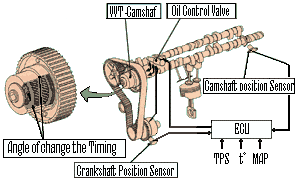
Система переменного газораспределения VVT-i (Variable Valve timing-intelligent) позволяет увеличить крутящий момент и мощность двигателя при одновременном снижении токсичности выхлопных газов и повышении экономичности автомобиля.
Toyota originally introduced the VVT-i (Variable Valve Timing - intelligent) as a revolutionary design that increases engine torque and output while addressing environmental issues.
By adjusting the intake valve opening timing according to the engine speed, more oxygen is supplied through the air intake valve as more fuel is injected into the combustion chamber. Power and torque is maximised due to larger scale combustion. This optimised fuel to air ratio ensures the air-fuel mixture is combusted more thoroughly.
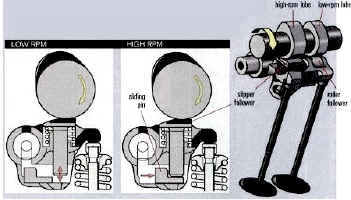
The VVT-i portion of the system continuously varies intake valve timing throughout the rev range by hydraulically rotating the camshaft relative to its drive gear. Note that VVT (without the "i") did not do this continuously. The VVL portion of the system incorporating two distinct cam profiles. However, the actual mechanism is quite different. Both cam lobes operate a single wide rocker arm that acts on both intake or both exhaust valves.
A needle-bearing roller on the arm follows the low-rpm, short-duration, low-lift lobe, forcing both valves to open and close on that profile. The roller design and roller bearings on the rocker arm pivot help to minimize valvetrain friction. The high-rpm, higher-duration, longer-lift lobe rubs on a hardened steel slipper follower mounted to the rocker arm with a spring. Even though the high-rpm lobe is pushing down further than the low-rpm lobe, the spring absorbs the extra movement.
At 6000rpm, the ECU sends a signal to an oil control valve at the end of the camshaft that puts oil pressure behind a lock pin in the rocker arm, sliding the pin under the spring-loaded slipper follower, locking it to the rocker arm and forcing the arm to follow the high-rpm cam profile.
VVTL-i (Variable Valve timing and Lift-intelligent)
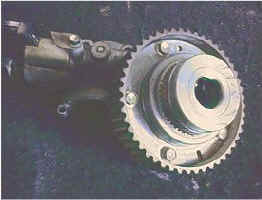
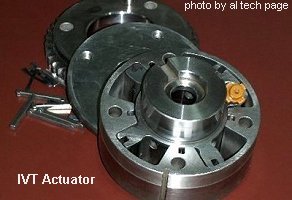
Изменение синхронизации открытия впускных клапанов позволяет увеличить количества воздуха, поступающего в цилиндры, и, как следствие, количество топлива подаваемого в камеру сгорания. Благодаря этому увеличиваются мощность и вращающий момент двигателя*. Изменение положения шкива распредвала относительно самого вала происходит с помощью перемещаемой шайбы при изменении давления масла подаваемого непосредственно в полость шкива. Управление давлением осуществляет ECM посредством "Oil Control Valve" в зависимости от режима работы двигателя. Масло в шкив подается через отверстие распредвала.

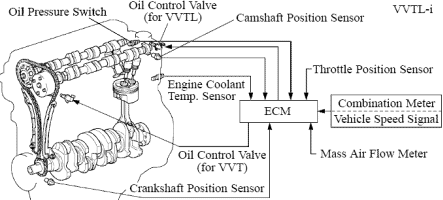
Неисправностям системы VVT (Toyota/Lexus) соответствуют и такие коды неисправности:
- P0010 Camshaft Position ”A” Actuator Circuit (Bank 1) [Camshaft Timing Oil Control Valve (Bank 1)]
- P0011 (old P1349) Camshaft Position ”A” −Timing Over − Advanced or System Performance (Bank 1) [Camshaft Timing Actuator locked at advance position (Bank 1)]
- P0012 (old P1349) Camshaft Position ”A” −Timing Over− Retarded (Bank 1) [Camshaft Timing Actuator locked at retard position (Bank 1)]
- P0016 (old P0336/P1346) Crankshaft position – camshaft position correlation (Bank 1 Sensor A) / Camshaft position misalignment (Bank 1)
- P0018 (old P1351) Crankshaft position – camshaft position correlation (Bank 2 Sensor A)
- P0020 (old P1663) Camshaft position “A” actuator circuit (Bank 2)
- P0021 (old P1354) Camshaft position “A” – Timing over-advanced or system performance (Bank 2)
- P0022 (old P1354) Camshaft position “A” – Timing over-retarded (Bank 2)
- P1010 (old P1690) OCV for VVTL circuit (Bank 1)
- P1011 (old P1692) OCV for VVTL open malfunction (Bank 1)
- P1012 (old P1693) OCV for VVTL close malfunction (Bank 1)
- P1345 (VVT Sensor/CKP Sensor Circuit Malfunction)
- P1346 (VVT Sensor/CKP Sensor Range/Performance Problem)
- P1349 (VVT System Malfunction)
- ... etc.
* For example,
3.0-liter 24-valve DOHC VVT-i V6 is 210-220 hp @5,800 rpm;220 lb.-ft.@4,400 rpm
4.7-liter DOHC 32-valve i-FORCE V8 - 240 hp @4,800 rpm;315 lb.-ft.@3,400 rpm
3.3-liter DOHC 24-valve VVT-i V6 230 hp @5,800 rpm, 242 lb.-ft.@4,400 rpm
VVT-i Controller (Helical Type)
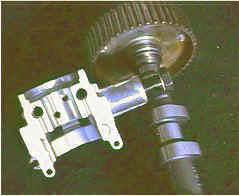

VVT-i Actuator (Vane Type)


Based on the VVT-i system, the Variable Valve Timing with Lift - intelligent (VVTL-i) system has adopted a cam changeover mechanism that changes the amount of liValve Overlap of 2AZ-FE Toyota Scion tC a '07ft and duration of the intake and exhaust valves while the engine is operating at high speeds. In addition to achieving higher engine speeds and higher outputs, this system enables the valve timing to be optimally set, resulting in improved fuel economy.
When the engine is operating in the low-to-mid-speed range, the low/medium-speed cam lobes of the camshafts operate to move the two valves via the rocker arms. Then, when the engine is operating in the high-speed range, the signals from the sensors cause the ECM to change the hydraulic passage of the oil control valve, thus changing to the high-speed cam lobes. Now, the lift and the duration of the intake and exhaust valves increases, allowing a greater volume of the air/fuel mixture to enter the cylinder, and a greater volume of the exhaust gases to leave the cylinder. As a result, the engine produces more power over a wider RPM range.
The construction and the operation of the valve timing control are basically the same as in the VVT-i system.
camshafts, with each connected to its respective rocker arm shaft. Both the intake and exhaust camshafts contain low and medium-speed cams and high-speed cams.
When the engine coolant temperature is higher than 60°C (140°F) and the engine speed is higher than 6000 RPM, this system switches from the low/medium speed cams to the high-speed cams.
When the engine is operating in the low-to-mid-speed range, the oil control valve is open on the drain side so that the oil pressure will not be applied to the cam changeover mechanism. Then, when the engine reaches a high speed, the oil control valve closes on the drain side in order to apply the oil pressure to the high-speed cam of the cam changeover mechanism.

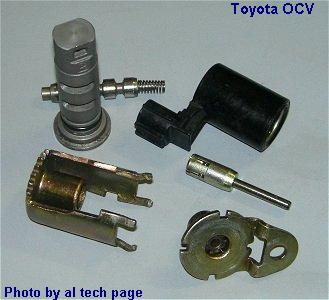
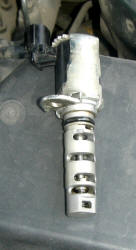
OCV Checking ("Ручная" проверка клапана OSC)
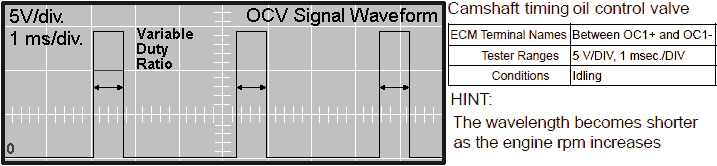
1. The Electronic Control Unit (ECU), which calculates optimum intake valve timing and decide whether or not to operate the cam changeover mechanism based on engine operating conditions.
2. The Oil Control Valve (OCV) for variable valve timing, which controls hydraulic pressure, and in turn the VVT Pulley, under instruction from the ECU.
3. The Oil Control Valve (OCV) for variable valve timing and lift, which controls hydraulic pressure to operate the cam changeover mechanism.
4. The VVT Pulley, which continuously changes the intake valve timing using hydraulic pressure.
Effect of Continuous Valve Timing Changes.
Smooth Idle - At idle rpm, valve overlap is eliminated by retarding the camshaft. With the intake valve opening after the exhaust valve has closed, there is no blow back of exhaust gases to the intake side. Now, combustion is more stable because of the clean air/fuel mixture. This allows the engine idle smoothly at a lower rpm and fuel consumption is reduced.
Torque Improvement in Low to Medium Speed Range - In the low to medium speed range with a heavy load, the camshaft is advanced increasing the valve overlap. This has two effects. First, the exhaust gases help pull in the intake mixture. Second, by closing the intake valve early, the air/fuel mixture taken into the cylinder is not discharged.
This improves volumetric efficiency and increases torque (and therefore horsepower) in the low and midrange rpm range. The driver notices a more powerful acceleration.
EGR Effect - VVT-i eliminates the need for an EGR valve. As a result of increasing the valve overlap in which the exhaust and intake valves are both open, the exhaust gas is able to flow to the intake side. Diluting the air/fuel mixture with exhaust gases reduces the combustion temperature and the production of NOx . Also, some of the unburned air/fuel mixture present in the exhaust gas will be burned.
Better Fuel Economy - A VVT-i equipped engine is more efficient and provides better fuel economy from a variety of factors. Without VVT-i, the engine would have to be larger and heavier to produce the same horsepower. Smaller pistons, connecting rods, and crankshaft reduce friction and mechanical losses. A lighter engine improves vehicle fuel economy.
Improved fuel consumption is also realized because of the further reduction in the intake stroke resistance. In the medium-load operation range, when the valve overlap is increased, the vacuum (negative pressure) in the intake manifold is reduced. Now, it takes less energy to move the piston downward on the intake stroke. With the pumping loss reduced during the intake stroke, more energy is available to propel the vehicle.
At idle, with no valve overlap, the idle speed is lower improving fuel economy.
Improved Emission Control Performance - In the light-medium load operation range, VVT-i increases the valve overlap creating an internal EGR effect. By opening the intake valve earlier in the exhaust stroke at a lower RPM allows the exhaust gases to push into the intake manifold mixing with the fresh air. The return of exhaust gas into the cylinder lowers the combustion temperature, resulting in NOx reduction. Essentially, VVT-i will increase the valve overlap to obtain the same EGR effect as an engine equipped with an EGR valve. In other words, when an EGR valve on an EGR equipped engine opens is when VVT-i will increase the valve overlap.
Another benefit is that HCs are also reduced. Some of the unburned air/fuel mixture from the previous cycle returns to the cylinder for combustion. Finally, C02 is reduced because of the decrease in fuel consumption.
Engine Control Systems I - Course 852 (2004)


Nissan аналогичную систему называет VVL(Variable Valve Lift & timing) и реализована она следующим образом:

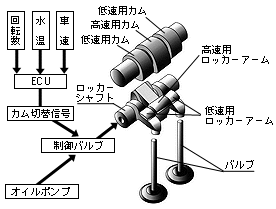
Это позволило на двигателе NEO VVL SR16 (1596cc)(N1レース仕様)добится:Horsepower (最高出力), kW/PS/rpm = 149 / 200 / 7800; Profitability (燃費) km/L = 12,2 M/T